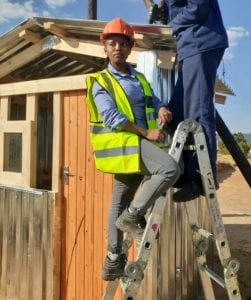
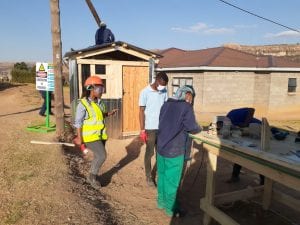
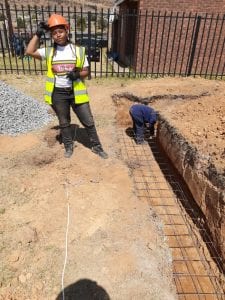
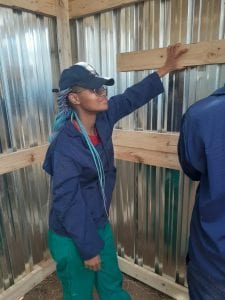
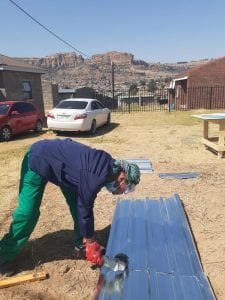
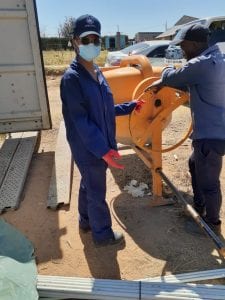
The United Nations declared July 15th World Youth Skills Day to be the day we all celebrate the importance of youth training and skills development. This day is dedicated to providing young people with opportunities to improve their skills by participating in programs designed to develop their entrepreneurial and work skills.
Skills development is at the core of our work at rise which is why the in loco fellowship program was created and launched 5 years ago. It is a “learning-by-doing” program where local graduates from the Design, Architecture, and Built Environment fields are awarded practical hands-on work experience while equipped with the skills to set up and run successful enterprises. We have had 3 successful cohorts since 2018 and are proud that 93% of our in loco fellows who graduate, called Pioneers, are now in self or full-time employment.
We are thrilled to announce that this year, we are piloting new ways of achieving our mission of youth skills development by partnering with Lesotho’s Ministry of Finance and their apprenticeship program for unemployed youth from which we are selecting the fellows.
Furthermore, we will be building a primary school kitchen using sandbag technology – they are fire-resistant, have good thermal efficiency qualities, and will lead to a possible affordable housing solution.
Developing the skills of the youth is at the heart of rise, every day is World Youth Skills day with us. Join our community of supporters and Subscribe to be a donor here.
Ireland’s Minister for Overseas Development Aid and Diaspora, Colm Brophy, T.D., announced on July 1st, the Irish Aid funding to strengthen the ability of developing countries to predict and prepare for extreme weather events. It is facilitated in partnership with Met Éireann, to enable the work of the Systematic Observations Financing Facility (SOFF), established by the World Meteorological Organization and the UN. The Facility is meant to work with developing countries, providing funding and technical expertise to help them to address weather and climate information gaps.
Minister Brophy in his announcement stated that: “We are living through a time when climate change impacts are already devastating peoples’ lives and livelihoods. Initiatives such as the SOFF are crucial to building the capability of developing countries to predict and tackle extreme weather events such as those we are witnessing today. I am pleased to announce Irish support for this innovative programme, which builds on our strong track record in supporting climate adaptation in the most vulnerable countries”
rise International in partnership with Irish charity, Action Ireland Trust, were awarded funding towards their proposed project along with only 3 other grantees. The research project, which will be driven jointly by Action Ireland Trust and rise will examine how Lesotho can move away from imported building materials that have high carbon levels towards local, indigenous construction materials, thereby reducing the overall carbon footprint of Lesotho. The project seeks to address Lesotho’s gaps in the research of sustainable locally sourced construction materials, enabling the construction industry’s transition to becoming more environmentally responsible, by replacing imported environmentally harmful construction materials with locally-made and recycled green products. The project will also examine how to build upon local capacity and to develop entrepreneurial skills in Lesotho, in addition to exploring how building regulations and standards in Lesotho can be enhanced. Additionally, this project aims to support policy makers in reviewing and revising outdated construction regulations and standards, regarding the use of sustainable material and construction techniques for energy efficiency in buildings.
Daniela Gusman, Founder of rise stated: “We are so thrilled with this news, as thanks to this funding from Irish Aid and our partnership with Action Ireland Trust, we are able to research indigenous building techniques and materials, as well as grow local entrepreneurship skills in Basotho traditional building techniques, so as to build Lesotho’s local economy. As well as the economic advantages, this project will also help combat climate change; not just in terms of the usage of more environmentally friendly building materials that have a lower carbon footprint, but also in terms of the construction of buildings that are more thermally efficient. This is especially important in a mountainous country like Lesotho, where the climate is extreme, with bitterly cold winters that get as cold as -15°C and hot Summers when temperatures hover around 28°C.” Fran Whelan, CEO, Action Ireland Trust said: “We are absolutely delighted to be selected as one of four grant winners by Irish Aid under the ‘Enterprise Fund for International Climate Action’. The project we are planning in Lesotho will create great opportunities in the development of more sustainable construction methods and materials. This research will be very beneficial to not only Lesotho, but also for other countries in Africa. It is a great honor to be the recipient of this grant at a time for urgent change and action around climate change and we look forward to continuing our work with Irish Aid and rise International”.
The Lesotho National Federation of Organizations of the Disabled (LNFOD) is an umbrella body of organizations dealing with disability in Lesotho. LNFOD advocates for, promotes, and defends the rights of people with disabilities and their families through provision of training, material and emotional support, and by representing their needs to government, development partners and the wider community.
The Problem
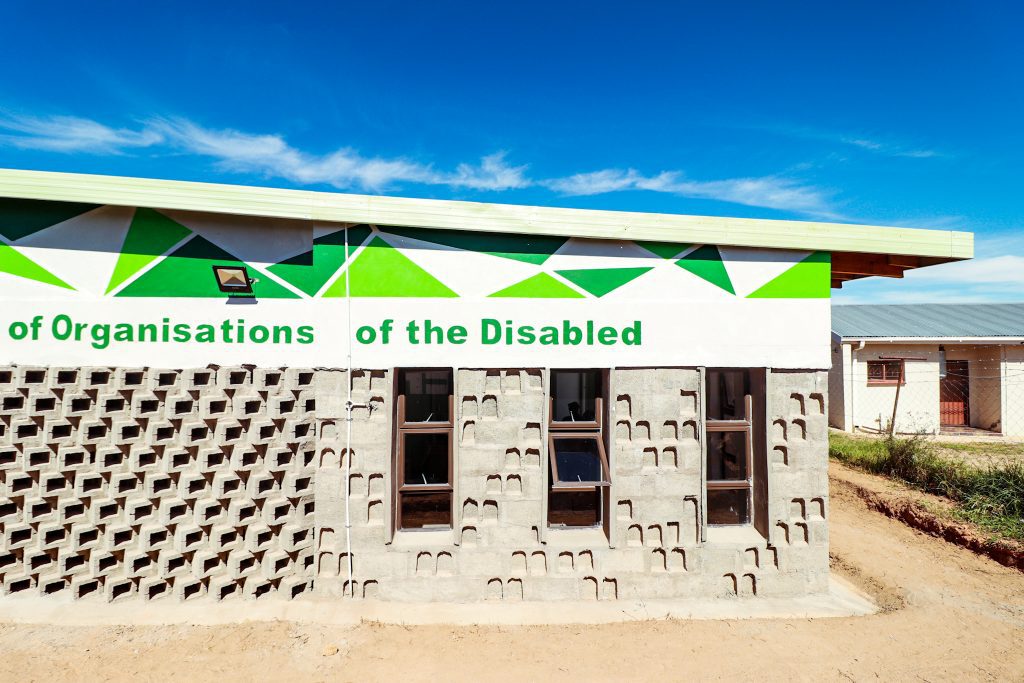
The building in which LNFOD used as their office was not accessible and inclusive of people living with disabilities. There were no ramps, sliding doors, or rails in the toilets. There were no pavements on the outside of the building making it difficult for people who use wheelchairs to access the building. There were also no guiding blocks to assist blind people and signage for general guidance and warnings. The building had poor ventilation and lacked thermal insulation. In essence, the office did not allow for the organization to employ people with disabilities nor fully carry out services for people with disabilities because of lack of accessibility.
The Solution
rise built a new all inclusive office in Naleli, Maseru the capital city of Lesotho. This building is the first one of its kind in the country catering completely for people with different disabilities. It has a ramp for easy access for people with physical disabilities, the doors are wide to allow wheelchair access, there are rails in the bathroom, the walls are made of textured tiles for guidance for people with blindness or eye sight impairment. The building has insulation in the ceiling as well as a cavity wall for insulation which makes it warm in winter and cool in summer. It is also designed such that there is a separate entrance for the boardroom and toilets allowing LNFOD to rent out the boardroom to external entities as an income generating source because social enterprise is the heart of rise.
Methodology
With the support of funds from Sedlak GmbH and Brotfür die Welt, the rise in loco cohort of 2020 designed and constructed this building. in loco is rise’s learning by doing program where
Young Basotho graduates from the design, architecture and built environment fields come together as a fellowship and learn practical skills. This way, graduates gained practical skills while the LNFOD community gained an inclusive office space.
Challenges
The site available for the building was very small, as was the budget for this project. Moreover this building was constructed during the Covid-19 pandemic, movement restrictions due to the pandemic restricted a lot of activities and decreased morale on site. People on site had to work with each other but still maintain Covid-19 protocol which was new and uncomfortable. Construction materials prices kept increasing due to high transport costs and restricted movements which further challenged an already budget-restricted project. Hardware stores would often run out of stock, which challenged progress on site. The International partners were not able to visit the project.
The Impact
LNFOD is a national umbrella body of organizations of persons with disabilities and therefore works for an estimated 56 000 people in Lesotho according to census (2016). LNFOD now employs more than 10 people with different disabilities and can provide even more services because of their fully inclusive new headquarters office building.
Testimonials
Nkhasi Sefuthi – Director of LNFOD
“We now have accessible toilets and ramps that make the office accessible for all people with disabilities including those using wheelchairs. We are now able to conduct our work efficiently even without the disturbances we used to have in our previous working space.”
SEDLAK GmbH and Diakonie/Brot für die Welt – Sponsors of the project
“We are proud to have supported the first accessible and inclusive office building in Lesotho. The construction of the LNFOD offices in Naleli is a milestone for disability organizations in Lesotho and will hopefully serve as a role model for other accessible buildings throughout the country.”
“Growing up in a clean and safe environment is every child’s right. Access to clean water, basic toilets, and good hygiene practices not only keeps children thriving, but also gives them a healthier start in life.” – Unicef
Lack of sanitation can be a barrier to individual prosperity and sustainable development. When children, especially girls, cannot access private and decent sanitation facilities in their schools and learning environments, the right to education is threatened. Poor sanitation puts children at risk of childhood diseases and malnutrition that can impact their overall development, learning and, later in life, economic opportunities. According to UNICEF, as of 2015, nearly one in ten children in Lesotho dies before reaching their fifth birthday. Too many of these deaths are due to the effects of unclean water and inadequate sanitation and hygiene, which increases a child’s vulnerability to disease and infection. Most of Lesotho’s ten districts report a high percentage of households using unprotected water sources, and about 20% still need access to improved sanitation facilities. That is why we have partnered with various organizations and entities to address this urgent challenge.
What rise has achieved so far…
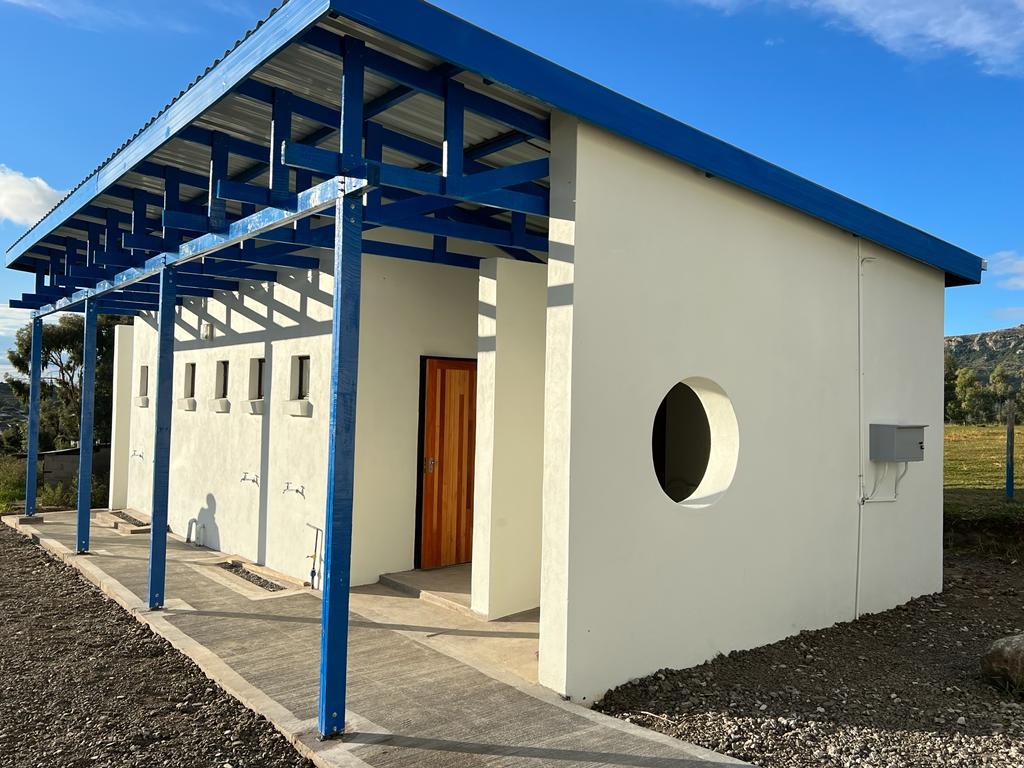
Toilets for a Primary School in Lithabaneng village
Ever since the existence of Seboka Primary School, over 600 learners yearly have endured poor sanitation due to a lack of healthy sanitation facilities and no running water anywhere on the school site. We are so proud of our in loco pioneers xyz collaborative for building new toilets for the learners and staff and Mokhethea Civils and Contactors for constructing the percolation system, as part of our 5 Hub Schools project thanks to the support of a not for profit organization called Action Ireland Trust (AIT) in collaboration with the Ministry of Education and Training of Lesotho.
Boreholes and rainwater harvesting for 5 Hub schools
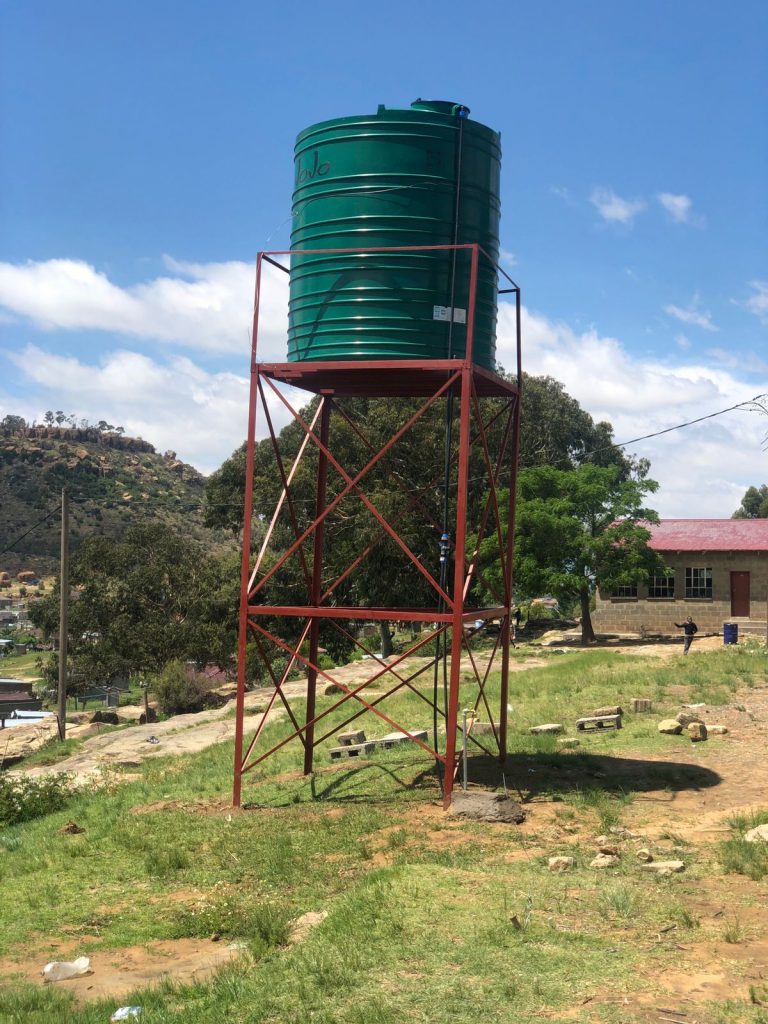
Our in loco Pioneers PRO Construction successfully constructed rainwater harvesting systems in 2 schools with the help of sponsorship from the British High Commission in Lesotho and AIT. The boreholes, together with the rainwater harvesting systems now provide a regular flow of clean running water to the schools, facilitating general good hygiene and frequent handwashing amongst learners and the schools’ community – an essential healthy habit in these Covid-19 ridden times. This access to running water also makes food preparation in the schools much easier, provides much needed water in the food gardens constructed by Green Yards, another in loco Pioneer company while promoting food security and food hygiene, and further supplies constant water circulation in the newly built toilets.
Why food gardens? You may ask. School lunch is the only meal that many of the learners in these schools get each day and therefore being able to grow their own nutritious food is vital for the learners’ feeding program and overall health & nutrition hence the construction of these food gardens. The schools are also able to sell excess produce to raise funds towards their operational costs.
No more outdoor cooking for another school in Lithabaneng village
The food preparation of over 600 learners was done in the outdoor area of Leqele Primary School. It is so amazing to have our in loco Pioneers Presto Construction Company build a new kitchen for this school also with clean water supply. It is integral that food be prepared, handled and served where there is access to running water.
Hand Wash stations for towns, hospitals, schools and villages in Lesotho during 1st wave of Covid-19
To curb the spread of the Coronavirus, we built handwash stations in all 5 schools in the Lithabaneng area which promoted hygiene and the safe handling of food. On the same mission, xyz collaborativebuilt 105 more hand wash stations which were installed in all 10 districts of Lesotho in various health clinics, hospitals, child care facilities as well as busy town areas in partnership with UNDP, UNICEF and the Ministry of Health.. We built 10 more for a semi-rural community called Motimposo to lessen the number of communities that did not have access to running water and were thus at the highest risk of contracting the virus.
Safely managed water, sanitation, and hygiene (WASH) services are an essential part of preventing and protecting human health especially during infectious disease outbreaks, including the current Covid-19 pandemic. Our mission is to ensure that young people exist in environments that allow them to develop so they can one day join the fight against poverty in Lesotho and the Subsaharan African region at large.
I remember my eleven-year-old self coming across a drawing which I later learned was a floor plan. I began to wonder how a simple drawing like the one I had seen became a house. I was quiet curious and really loved to read a lot as a child. I then learned that for every structure to be constructed it had to be drawn first. However, a bigger question remained; how is construction carried out? I guess that’s why I ended up pursuing a Diploma in Civil Engineering.
I am Ikhetheleng Moshoeshoe, a 24-year old woman born and raised in the Mountain Kingdom of Lesotho. I am a fellow with rise international’s in loco fellowship 2020 cohort. I have big hopes to make real changes in my community and the economy through entrepreneurship. As a fresh graduate from school with little on site experience, this fellowship seemed like a great opportunity to enhance my skills and to become more employable. So when I joined the rise family, I was looking to gain practical experience, not knowing there would be so much more to gain.
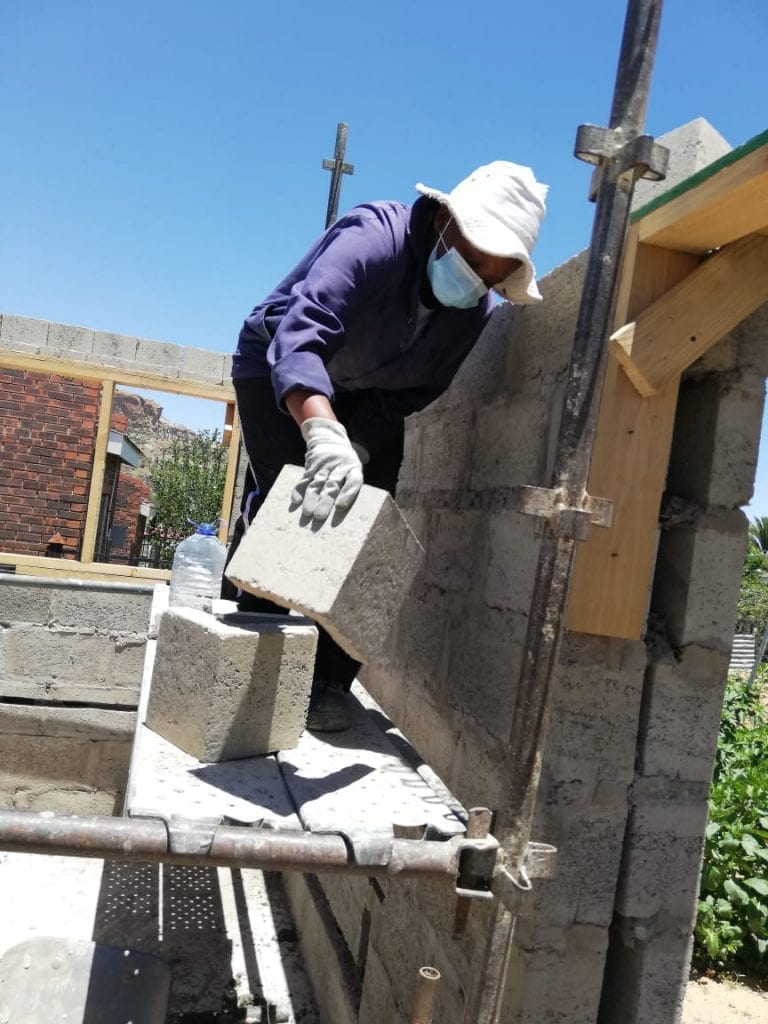
Ikhetheleng brick laying
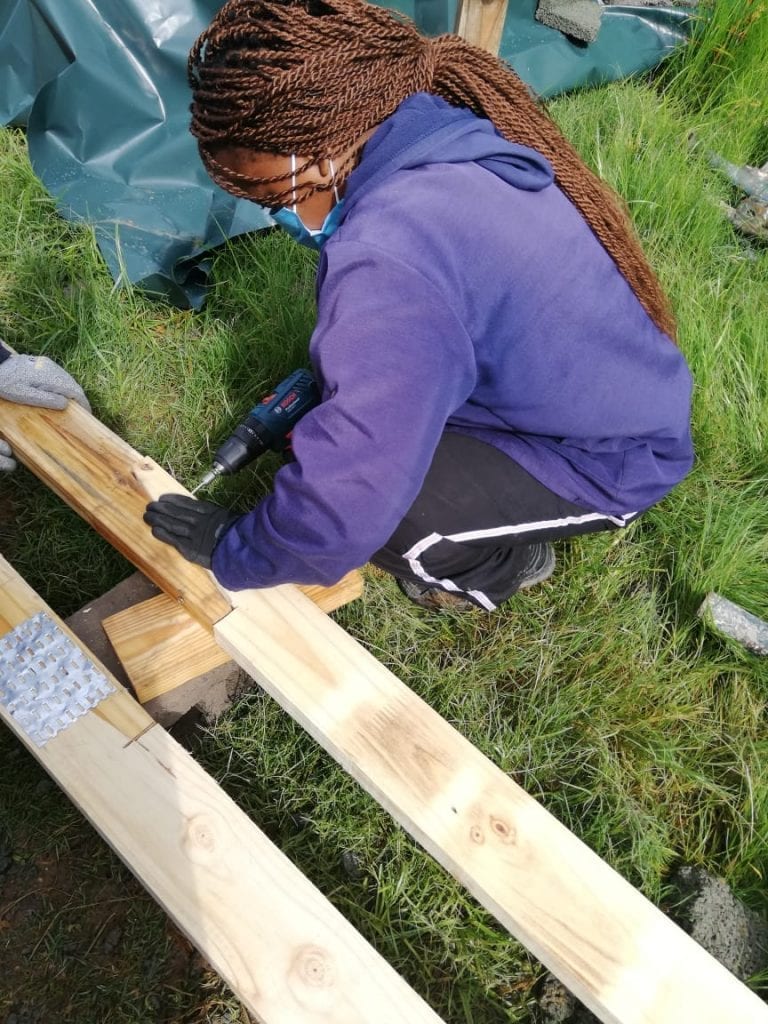
This fellowship has provided me with valuable skills which I can use to start my own enterprise in future. It also supports the fellows through resource and professional networking which is great for building a business entity. I read somewhere that in a man’s world, a woman has to use both her brains and beauty. The past 6 months that I have spent here has taught me to change the narrative to “use her brains and gets her hands dirty”. Through labor intensive work and working with different people from numerous disciplines of the construction industry, I have learned and still continue to learn the key activities involved in construction. Some of these include project preparation, bricklaying, carpentry, roofing, electrical and plumbing works. I also got to experience the challenges involved in construction first hand which according to me is one of the best ways to ever master anything.
Ikhetheleng constructing a roof truss structure
During the design stage of the project, I was part of the research team. This was where we went out to do research on different types of material and their availability while building a relationship with the suppliers. As a shy person, this task helped me work on my communication skills and it was a definite boost to my confidence. I have also been involved in purchasing materials playing the role of a buyer. This was a very challenging role since I also had to negotiate prices from our suppliers to ensure that we stick to the budget as per the Bill of Quantities. Since we work as a group, this fellowship has been a platform where I get to show my teamwork skills while also learning from other fellows.
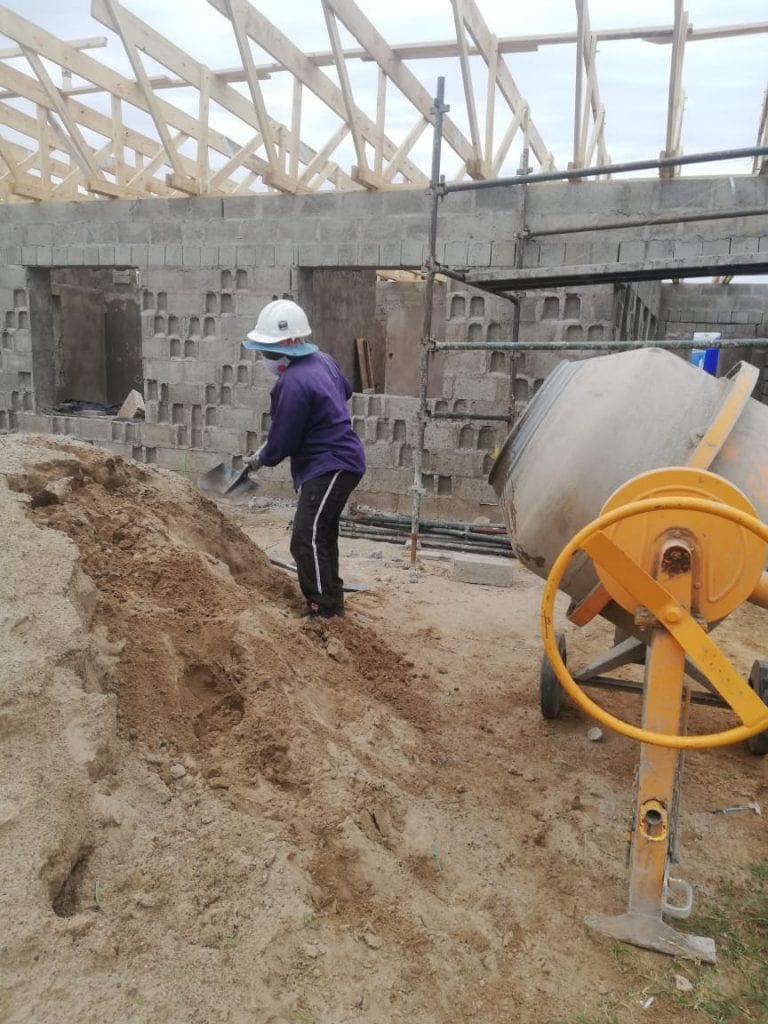
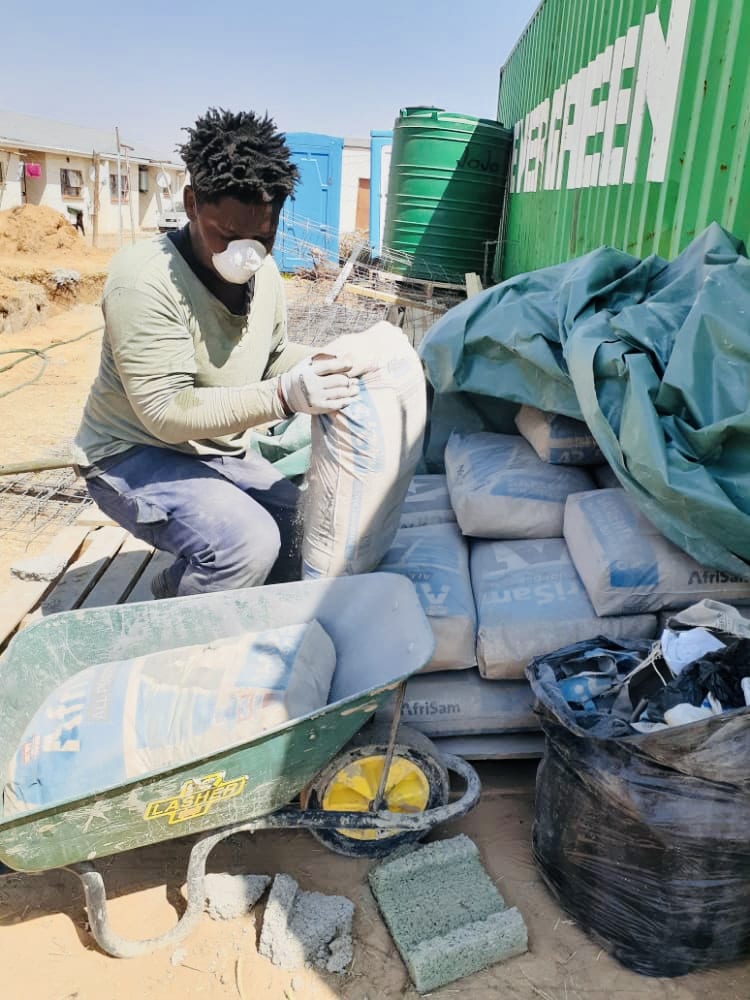
Ikhetheleng preparing concrete
Even though more women are progressively and proudly making their mark, the built environment is still a male dominated industry. My dream is to change that and through the entrepreneurship training that I get from rise, I am at a very big advantage. These sessions have changed my mindset from working towards being more employable to wanting to be an employer. I am confident that I have acquired enough tools to help me start my business. In addition, the in loco fellowship provides a mentorship program which propels me into professional networks and spaces, by learning from and interacting with my esteemed mentor.
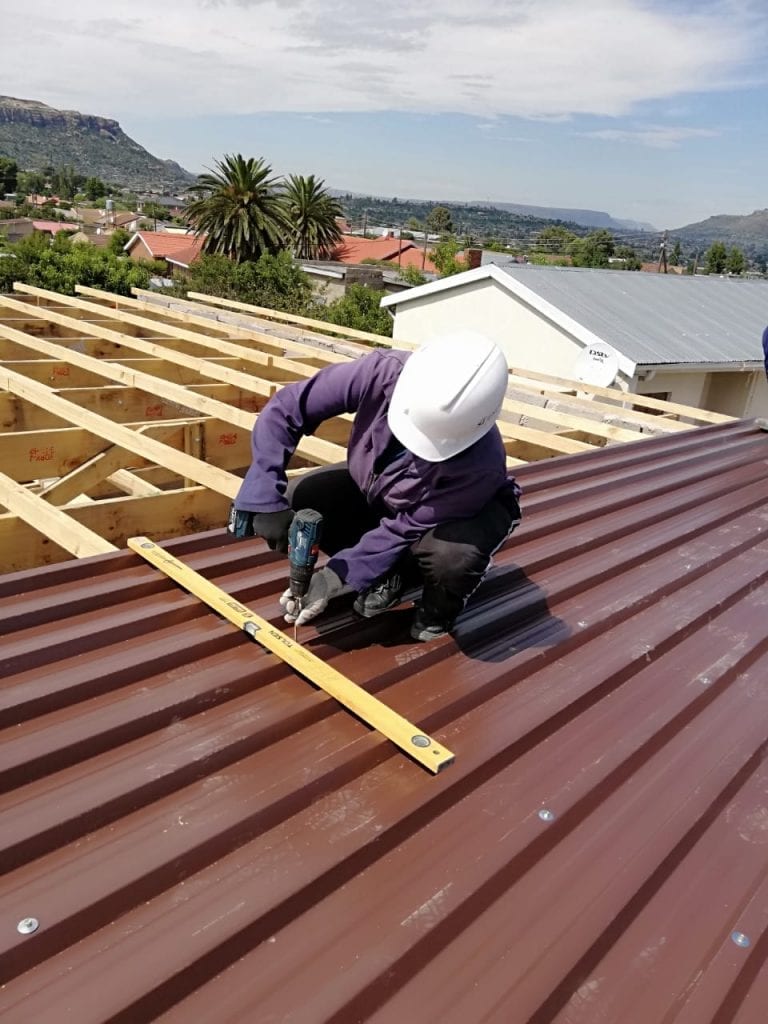
Ikhetheleng placing roof sheets
One of the most inspiring aspects of rise as an organization is giving back to the community. We are currently constructing offices for LNFOD; the first of its kind in the country. This building will be user friendly to all people living with disability. With a cavity wall to ensure improved thermal efficiency throughout the building so as to reduce heating and air conditioning costs and a beautiful screen wall. Our main aim is to reduce costs and challenge construction methods while abiding by the SABS housing and environmental standards and not compromising lives and the durability of the building. This really requires an open mind. We also get to work with amazing architects from in and out of Lesotho. I am very grateful for this opportunity and excited to learn more in the remaining month.
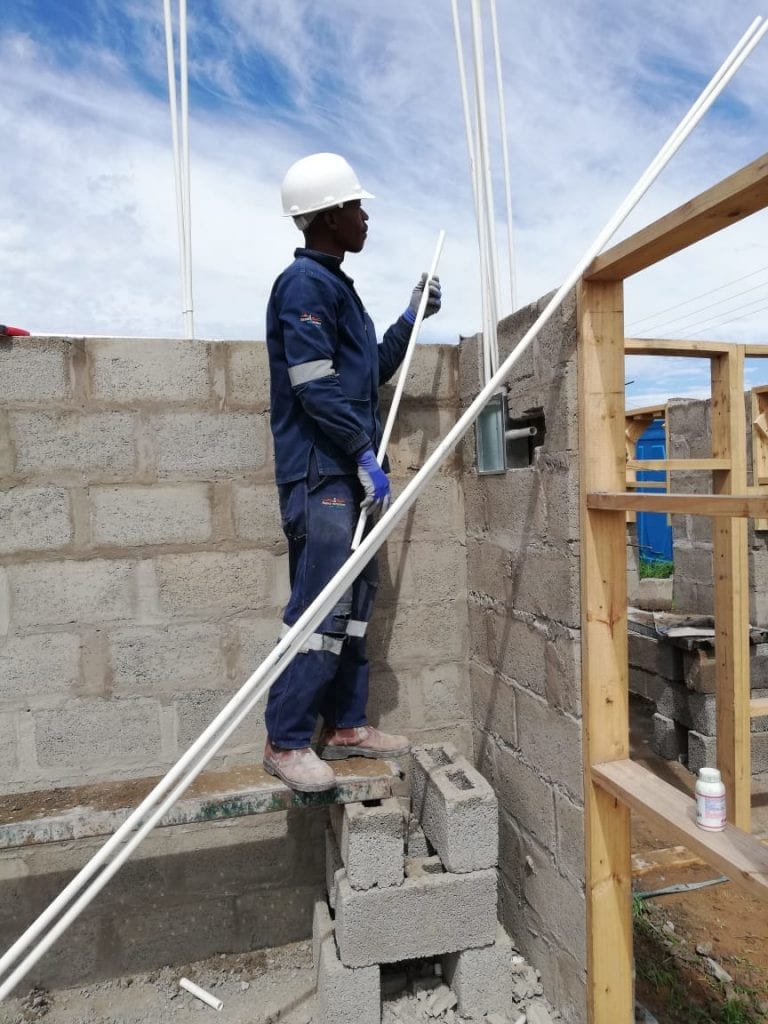
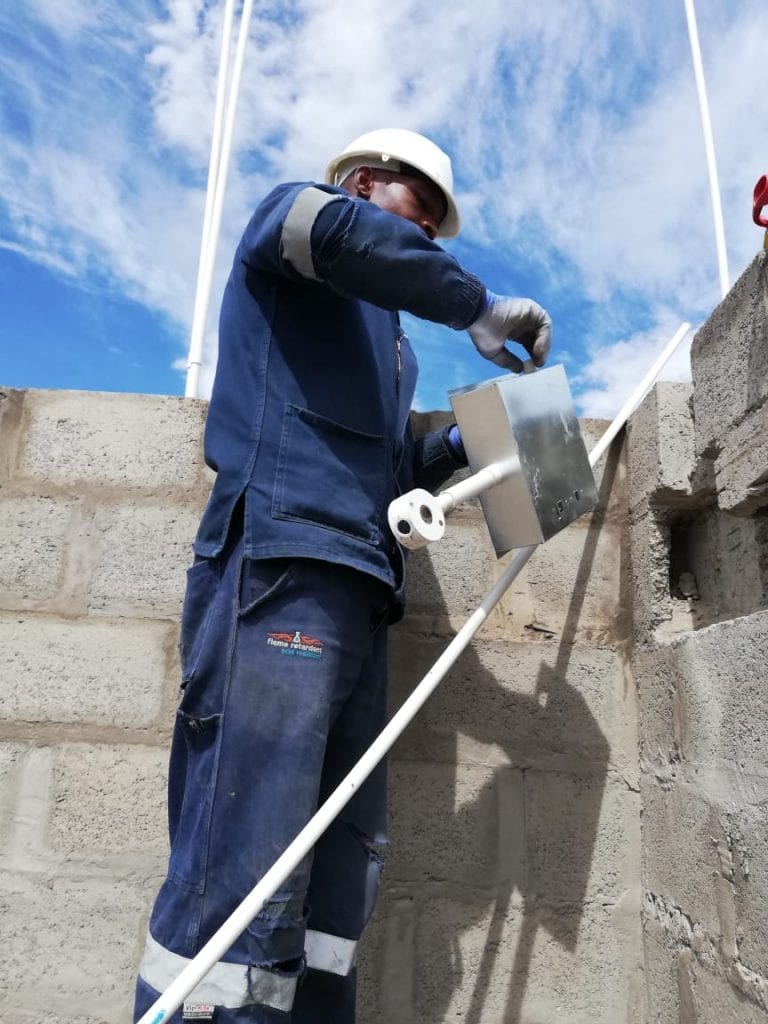
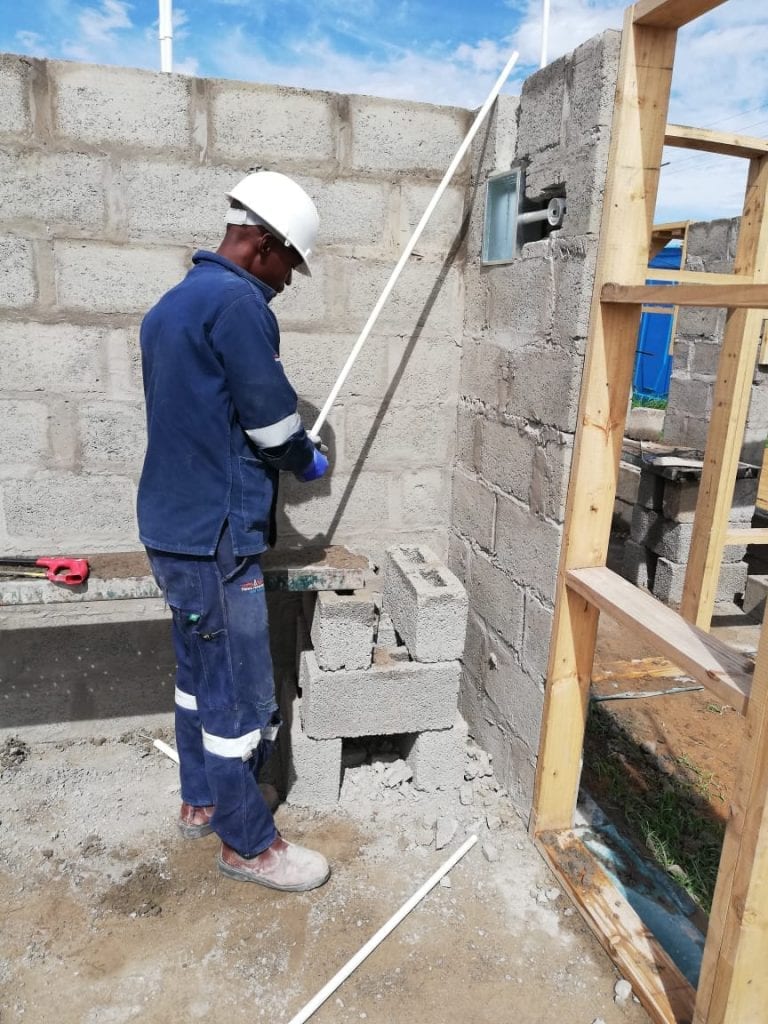
My name is Poloko Phalinyane. I am a twenty seven year old Mosotho man born in Rothe, in the outskirts of Maseru. I studied Electrical Installation at the renowned institution of Lerotholi Polytechnic. I enrolled in 2015 and completed in 2018. I am part of the in loco fellowship of 2020 with rise international. What sets me apart from a crowd is my work ethic and desire to produce excellence in everything I do. I am a patient person and I act promptly in every task; giving it all of my time and attention. I am a person filled with laughter and always willing to offer a helping hand.
The most important of all reasons why I applied for the in loco fellowship is the entrepreneurship aspect of it all. I was curious about the business trainings provided in the fellowship – on how they can improve and add value to the informal business I was already running. Although at the time I already had much experience in the built environment through offering services in electrical installation and installing building finishes, I knew that I could learn more. That is what is currently happening in my time at the fellowship.
At this point in the fellowship, 4 months in, I have acquired a lot of skills and lessons that I didn’t have before. In line with the entrepreneurial training, I have learned how to keep documentation of all transactions, budgeting skills, how to improve my negotiation skills, how to position my brand, and how to advertise my business. In construction I have learned about the inception of construction cycles, what tenders are and what they deal with, the preparation of the Bill of quantities, preparation of electrical drawings, technical skills in building foundations, surface bed and a cavity wall.
As a Mosotho man I want to be an example to the community I come from. I want to be an attestation that hard work, discipline and laughter are ingredients of success. I want to build my skills not just to work for an existing company but to run my own enterprise one day. An enterprise built from scratch by a Mosotho man. One that can be successful and uplift the Basotho youth by providing jobs and convenience for communities in the outskirts of Maseru. Owning an electrical store that is situated in the north of Lesotho is the one dream I really want to come true. I want to transition from old ways of making my services available to customers and incorporate digital platforms to keep up with the times because digital media has taken over the world.
Growing up I never had a specific aspiration but I always knew that in everything I choose to do, I shall always give it my all. Lesotho has a high unemployment rate and opportunities are very scarce so it’s no surprise that I want to be a successful entrepreneur, it is one of the major motivations to make money and secure a comfortable future. There is a saying that says the early bird catches the fattest worm and every day when I wake up I work towards catching the fattest worm.
My name is Paki T’sotleho, I am a 29 year old man with a heart of a kid, a mind of an old soul and the body of a giant. I am part of the 2020 cohort of the in loco fellowship and a contributor to the vision set by rise international. I hold a Bsc in Construction studies in the built environment from the University of the Witwatersrand. This program focuses on all aspects of construction; from Construction Management and Technology, Quantity Surveying, Property studies, Construction law, Building design, Building science and Construction Economics. The importance of this programme is to broaden one’s take on the construction industry so that going further with either a professional career or a contractor/ entrepreneur route you understand your role and how you fit in and keep up with the ever growing and changing construction industry.
Paki working on site
I strongly believe that ignorance, coupled with the “know it all” attitude is the root of the downfall of our Basotho People and hinders growth for Lesotho. In return this attitude leaves us, the youth, with a frustrated and discouraged outlook for Lesotho. With that said, the reason I applied for the in loco fellowship programme was that for the first time I came across a programme that seemed eager to give the young Mosotho child a vision, a platform to voice their creativity, challenge and grow their acquired skills from the built environment and at the same time teach them how to be independent and to self-sustain themselves when they go out into the field.
At this stage of the fellowship programme (3 months in), I have learnt how to breakdown Bills of Quantities into a material list. They can be used as a point of reference to see if your project is in line with the budget and indicate expenses that were not accounted for in the Bills of Quantities. I have also learnt the most tricky aspect of construction which is the Preliminaries in a practical sense, that has to do with site preparation, site establishment requirements, administrations and organisational requirements for the personnel on site. On top of the construction aspect of the programme there is also the entrepreneurship aspect. In this part of the programme I continue to learn about how to position your brand, how to locate and expand your market, how to execute social media marketing, the importance of customer service, and a whole lot more that helps you tick all the boxes necessary to successfully start and operate your business.
Since the fellowship started in July 2020 I have been performing the role of a buyer as well as a laborer on site. As a buyer, I am responsible for making sure all the tools and materials needed on site are sourced in accordance with the construction schedule; when they are needed and at the best value for the client. I assure you this is no walk in the park. Finding the balance of being within budget but trying your best to get the best quality material and services possible is very challenging. This role requires a lot of planning and preparation skills but it is mostly exciting if you have worked as a consultant Quantity Surveyor like I have.
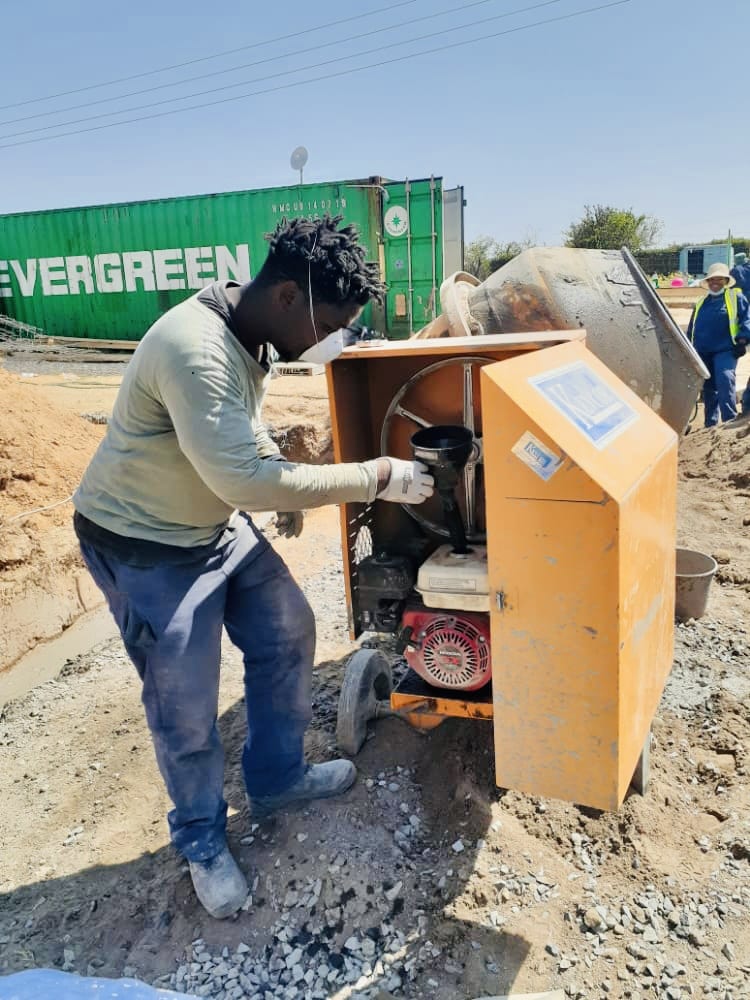
Paki operating cement mixer
Being able to see equipment and material, to interact with suppliers, all of which makes me feel hands on. It also solidifies my confidence in my profession as a Quantity Surveyor – this profession in Lesotho is easily brushed off and given little to no recognition. As for being a laborer, this is the most rewarding experience ever – I get to see that I am capable of creating something from nothing with my own hands and personally, I have always wanted to be the kind of man who is handy. So this experience is giving me the skills I need to be this man and tuning my mind to be oriented in problem solving in every task I face.
I am currently working in a project where we are constructing an inclusive building for LNFOD (Lesotho National Federation of the Disabled). The in loco programme encourages fellows to advocate for inclusive buildings in every project that we take on for the benefit of people with disabilities. Secondly, this project challenges us as the future Lesotho construction industry; to come up with the technology to allow for all physical work to be done by everyone, no matter their gender.
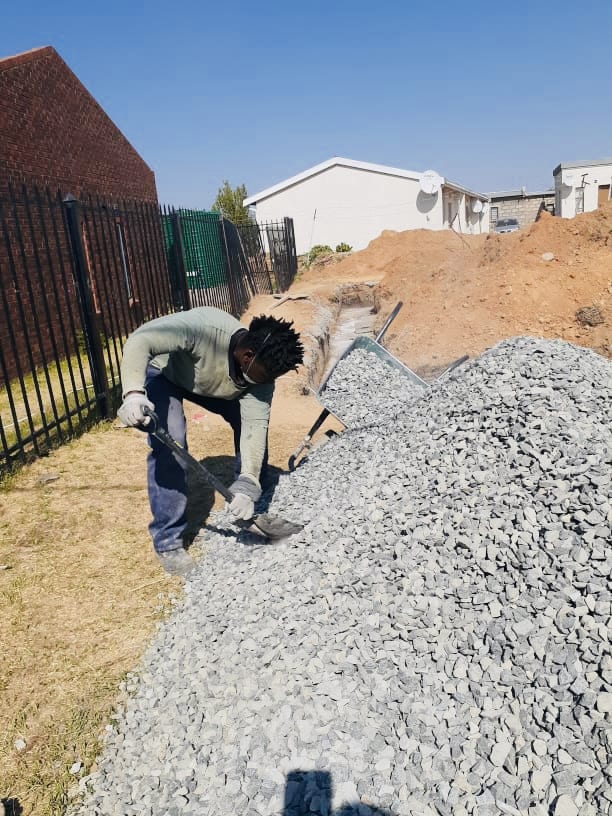
Paki preparing foundations
In conclusion I would like to leave with an overview of my future aspiration. My dream is in three stages; first I would like to open a lamp shop and everything wood that will later have a coffee shop. Secondly, I would like to start up a recreational center/camp, and lastly to facilitate community projects that build parks with sports grounds all over the country. “Along with the trees, the animal in me and the soil I ground myself on, teaches me how to be human” – Paki Ts’otleho
Intergalactic means movement between spaces. Buildings occupy space, from their foundations upwards. Therefore in this blog, intergalactic is compared to construction because of the fuming passion I have for the built environment and intergalactic.
My passion for the built environment grew after several setbacks from the University of Free State, where I was enrolled in the faculty of natural sciences, however I dropped out from the University and I enrolled for a National Diploma: Building at the Central University of Technology, Free State (CUT) where I graduated in record time. The faculty of Engineering has always been best for me…HAHA.
Malingaka working on construction site
Upon completion of my diploma, I was awarded a MerSETA women in engineering bursary. This encouraged me to further my BTech in Construction Management which I also completed in record time. A fiery love for construction grew deeper, so much so, that I established my own construction company named Khal Construction Engineers the same year I enrolled for my BTech, with a view of creating a better industry that would lessen surplus costs, delays, accidents on construction site, and upsurge job creation. My first project in construction was plastering and floor pouring a residential building.
The business did not go so well. Our marketing was poor, we could not get customers as we were unknown in the industry, project hunting became all-consuming but there were still no doors opening for the smart, enthusiastic ‘Malingaka. But I don’t accept defeat; it’s just not in my DNA. Therefore I enrolled for a Masters at the University of Johannesburg while job hunting and tender hunting. Being the go getter that I am, I completed my Masters within a year. The same year in December my company got its first client! Sufficient grace, right?
Malingaka building a guard house
That first client was a stepping-stone to many. Currently I have over two years’ experience in the industry and already embarking on the journey to bag my PhD in Construction Management. Though my business is facing challenges such as lack of construction equipment to commence a project, rise has a solution to my challenge since fellows and alumni are able to borrow construction equipment from rise.
My first encounter with rise international was when I navigated through the internet for job vacancies. I believe it was through www.selibeng.com that I saw the opportunity for the in loco fellowship. rise’s mission and vision caught my attention, I was amazed. With much enthusiasm I applied for the fellowship and got in. I must say I am super grateful for this platform; it has been nothing but a place of growth in the built environment, industry and entrepreneurship.
Malingaka and other in loco fellows working on LNFOD site
“Don’t let an opportunity pass you by, grab it and make the most of it.” I’ve been doing the most, learning by doing, learning from my other fellows, grabbing every skill and networking. rise has taught me that “Letso’ele le beta poho”, (Together we can overcome). Team work is the utmost, sharing innovative ideas amongst the fellows, problem solving and building each other through business partnerships. At rise, I have learned the importance of marketing, effective communication, negotiation skills and working in groups with other fellows. Amongst the activities we’ve done with rise, I enjoyed the Participatory Design Workshop and team building the most; what an experience!
‘Malingaka Maoeng
I am excited to learn more from my fellows, to experience getting our hands dirty on the 2020 project. I have been getting along well with other fellows; it has really been fun working with each and every one of them. It is as if we’re one big happy family.
An Enterprise Hub in the entrepreneurial sense is a kind of greenhouse for start-up enterprises. In this protected incubation environment, entrepreneurs with innovative business ideas can be consulted and trained. Incubation Hubs are contact points for entrepreneurial learning, thinking and connecting people where they share, network and mutually benefit from one another.
The importance of having an Enterprise Hub in Lesotho is immense; a place of this nature would be able to open up multiple doors for entrepreneurs and is currently an essential missing piece in the entrepreneurial ecosystem. With the unemployment rate in Lesotho as high as 30% amongst youth, there is a dire need for young people to go into business in order to make a living for themselves and their families. The rate of poverty in Lesotho stands at almost 50% , which calls for an urgent need for Basotho youth to be motivated, skilled and well equipped to create platforms for employment and thus fueling the country’s economy.
The Hub will represent an environment in which aspiring entrepreneurs can prosper in the entrepreneurship learning space. They will gain access to essential business development services from business and financial planning to legal and human resource spets. They will get to share their knowledge through peer to peer interaction, while at the same time having much needed space in terms of offices, meeting rooms and workshops to experiment their ideas and create prototypes of their forthcoming products and services before taking them to market. The Hub will also offer access to market and act as a referral centre linking startups to clients and potential investors, thus being a centre of business excellence acting as a benchmark for other businesses in the country. The existence of this Hub will inspire innovations that could change the livelihoods of a significant number of people living in Lesotho.
An Enterprise Hub therefore signifies a ray of hope for multiple entrepreneurs in Lesotho who have great ideas and new businesses, but lack the platform and tools needed in order to make these ideas and enterprises flourish. The Hub will also be a place of inspiration for the Basotho nation at large; a place where some of the wildest dreams are born and attained, a place to birth some of the most successful businesswomen and men to ever come out of the Mountain Kingdom. To make all this happen we need to raise $100,000 by December 30, 2020. Learn how you can help here You can read more about the plans for the Enterprise Hub here
My name is Mosa Nkhabutlane, “kengoananaoamosotho”, (I am a Mosotho girl) who was born & bred in Lesotho. I studied Interior Architecture from the University of Pretoria and I am currently an in loco fellow at rise international. I applied for this program because I wanted to equip myself with an entrepreneurial career in the built environment and creative sphere in Lesotho.
Mosa helping to set up the site office
Being part of the 2020 cohort, we are currently designing LNFOD (Lesotho National Federation of Organizations of the Disabled) offices which are going to be located in Naleli. With these offices, we hope to create a precedent for inclusive design in the country. It’s been a real joy to be learning about inclusive design on a practical level so early in my career. So often, we can allow our egos as designers to get in the way of the buildings and objects we are designing and in doing so, we neglect the people for whom we are actually designing and creating. rise has been really instrumental in guiding us as to how we can design in an inclusive manner.
Mosa constructing the guard house
Before we started designing the LNFOD Offices, we met with LNFOD Staff & the Naleli Community. We then hosted a Participatory Design Workshop with LNFOD, which allowed us to communicate with our client and to find out what they need. Instead of assuming their needs, we listened to them, we learnt about how they function as an organization and in doing so, our design has been informed by the needs of the user.
My experience at rise thus far, as an in loco fellow, has been one of growth and I hope it continues to be exactly that for the months that follow. We have just begun going to site and I believe that it is the “learning by doing” that is yet to mould us into holistic professionals.
In addition to architecture & design, I am also an entrepreneur at heart. I started a jewellery brand @madebymos in 2018. My brand has really allowed me to express myself, it is a baby of mine that allowed me to grow in a lot of different ways and to learn about the design business. It is through it that I learnt about creating campaigns, creative direction and the art of making. I have also learnt to respond to the needs of the customer and I am continuing to learn about managing the funds of a business. I believe that we need to equip ourselves as small businesses, in order to build sustainable businesses.
Mosa working on the LNFOD construction site
The business trainings that rise holds have been a great resource for me as an entrepreneur. We get to meet some of Lesotho’s greatest minds through these workshops and we are given the opportunity to learn from them. The opportunity to absorb knowledge from entrepreneurs who are making waves in this country is unmatched, especially because they are also born & bred in Lesotho. To be inspired by the people that look like us and have walked similar paths is a breath of fresh air. It feels like I am learning something new every day ever since I have been a part of the in loco fellowship. Some days are easy and mellow, some are challenging and new but most importantly, I continue to learn & to be equipped as a young, black female designer in the Mountain Kingdom.